Mermaids and merfolk are the most well-known fairies of the sea, and all around the world, mysterious and alluring stories about mermaids have fascinated people for thousands of years. There are many types of merfolk who inhabit the waters in countless places around the world. The following are a few.
1. Merfolk
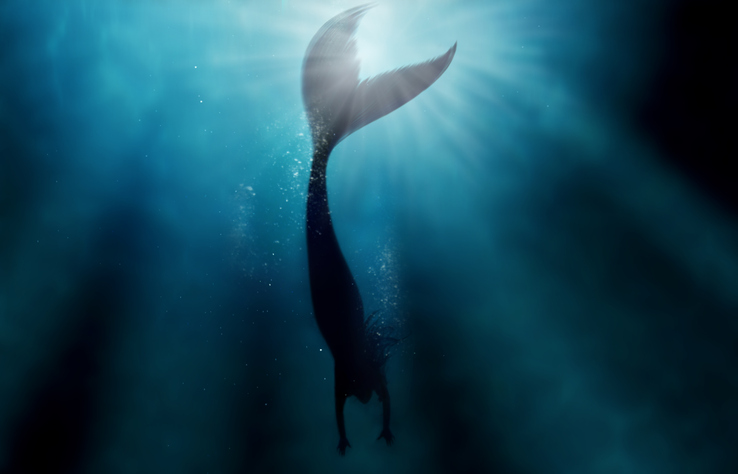
The mermaid is an iconic sea creature with the upper body of a woman and the lower body of a fish. In addition to being idealized and always exceedingly beautiful, the mermaid reputedly possesses secret knowledge of the sea. The quintessential mermaid was frequently depicted sitting on rocks at the water's edge and usually combing her luxurious hair. Magic mirrors, singing, and enticing sailors—often to their deaths—were standard components of her legends. The mermaid could be helpful and healing or vengeful and dangerous.
In England, other names for a mermaid include merwoman and merwife (the term "wife" does not refer to marital status); in Cornwall they are known as the merrymaids. In the Shetlands, mermaids are known as selkie wives, and should not be confused with the selkies, seal-people. In Wales, Gwenhidwy is a shepherdess mermaid whose sheep are the foamy waves; according to weather lore, if her flock was being driven toward the shore, a heavy storm was approaching. The mermaids of the Isle of Man are known as the ben-varrey and said to put spells on the human men they fancied.
Sometimes known as tritons, legends of mermen have been prevalent worldwide. Unlike their female counterparts, mermen were mostly said to be very unattractive, generally unfriendly to humans, and frequently deadly. According to a newspaper story in Maine, there was an encounter with a merman during September 1639 in Casco Bay near Portland. Unfortunately, as such situations often unfold, it did not go well for the merman and he was killed. Well into the early twentieth century, Maine sea captains reported seeing merfolk.
2. Merfolk of Scandinavia
Like the merpeople of the British Isles, these magical beings were believed to live under the sea in a fairy-like paradise or in sea caves but with one major difference: they could come ashore. Unlike the merman of Britain, in Denmark the havmand (half-man) was usually described as handsome and friendly to humans. Known as havstrambe in Greenland, this merman was sometimes described as having blue skin. The havfrue and havfru (mermaid) of Denmark and Finland, respectively, could be a friend or a foe to fishermen, as her presence would usually foretell of approaching storms. Similar to the Welsh Gwenhidwy, they were said to drive their white cattle toward the shore. The havfrue of Denmark were said to predict important events. In Norway, mermaids were almost always regarded as bad omens. However, according to Icelandic folklore, the haf-fru (sea-maid) was only occasionally dangerous.
3. Freshwater Mermaids
Although belonging to the sea, merfolk were said to sometimes travel into estuaries and upriver as far as the salmon swam. The city of Warsaw, Poland has a mermaid as its symbol. According to a legend pre-dating Danish author Hans Christian Andersen's story "The Little Mermaid" by several hundred years, the syrenka (mermaid) and her twin came from the Baltic Sea. The legend says that one of the twins stayed in Copenhagen while the other followed the rivers until she arrived at Warsaw, where she became the city's defender. As early as 1622, she appeared on the city's coat of arms holding a sword. A large statue of her still stands in the old town square.
There are also legends of merfolk from the fresh waters of Lake Geneva, Switzerland; Mummelsee Lake in Germany's Black Forest; and Blakemere Pond (Black Mere Pool) in Staffordshire, England—as well as in many other locations. In Austria, the Nörgl (merman) and Nörgin (mermaid) inhabit Tyrolean lakes.
In Ireland, Lí Ban or Liban, the fairy woman guardian of the freshwater lake Lough Neagh, is notably described in most accounts as a mermaid. She was so popular that a local bishop baptized her and in the sixth century she was sanctified and became known as St. Muirgen, a name that means "sea-born." She was given her own feast day of January 27th.
4. Ireland's Merrows
While Ireland has mermaids and mermen, it also has merpeople known as merrows, who use red caps for traveling through the sea to their dry-land home at the bottom of the ocean. The charmed cap was sometimes described as covered with feathers, and if it was lost or stolen, a merrow would be unable to return home. They are generally—but not always—portrayed as peaceful and sometimes intermarried with humans. The offspring of such a union were said to have webbed toes and fingers; however, in some accounts, female merrows were said to have white webs between their fingers and green hair, which was often exceedingly long. Merrows like to dance on the beach at night, and music was sometimes heard coming from under the sea. In County Kerry, merrows are regarded as unlucky and fishermen generally head back home if a merrow is spotted on a rock. According to legend, a merrow was often seen on a small rocky island in the estuary of the River Shannon.
5. Finfolk of Scotland
There are extensive legends about the finfolk (or finnfolk) in the Orkney and Shetland islands. Also known simply as finn, they are often distinguished by gender as finman and finwoman or finwife. Mostly human in form, they have long fins that can be draped around their bodies to appear as though they were wearing clothing when they go ashore. Finwives were said to be able to pass as humans and sometimes lived ashore amongst unsuspecting islanders. Unlike other merfolk mentioned so far, the finfolk were said to be shapeshifters. The finfolk were said to dwell in the sea as well as on land. Their underwater city of Finfolkaheem has been described as being surrounded by beautiful gardens of seaweed. Overall, finfolk were described as having a grim and gloomy countenance. Finmen were generally unfriendly to people, especially fishermen who worked the waters near islands inhabited by the finn. Fishermen sometimes found their boats vandalized when anchored near them at night. The finmen liked playing tricks on fishermen, yanking on their lines until they broke or a man was pulled overboard. They were also said to have the ability to control the weather, giving smooth sailing for the few fishermen they liked or producing storms to hinder those they especially disliked.
6. The Blue Men of Minch
The ocean around the Western Isles of Scotland is home to the blue men of the Minch. The Minch is a channel that separates the Outer Hebrides from the mainland and the Isle of Skye. The blue men are described as being of human form and size, with grayish-blue skin and long faces. Some accounts note that they have gray beards, others that they wear blue caps. Legends about them stretch back hundreds of years but never mention any female counterpart to the blue men. (Perhaps they were off on their own adventures and never seen.)
The blue men were said to keep the water restless even in good weather and to raise the height of waves with a simple gesture of their arms. When so inclined, they were said to bring up storms to wreck ships. Legends say that the only time the Minch Channel water is calm is when the blue men sleep in their underwater caves or when they relax and float along on the surface of the sea. Occasionally helpful to humans when treated with respect, their moods personify the changeability of the sea, which can quickly turn treacherous. According to legend, fishermen from Lewis, Harris, and Skye reported that their boats were occasionally followed by large numbers of blue men. However, before attacking a ship their leader Shony would give a verbal challenge in Gaelic verse, to which the ship's captain had to appropriately reply. It was a duel of rhyming couplets, and any captain who failed the test would have his ship capsized. In similar tales, the blue men were said to board ships and demand tribute.
7. Merpeople of New England
The Mi’kmaq and Wabanaki people of Maine and Maritime Canada have mermaid legends. In Mi’kmaq lore, the merfolk are called sabawaelnu (halfway people) because they are half human and half fish. Although they have the power to raise formidable storms with their singing, if treated with respect they are helpful to people and warn them of bad weather. According to legend, people who learn to interpret sabawaelnu songs gain the ability to predict storms. It was customary to give them gifts of tobacco. According to the Wabanki, there are two types of mermaids. The lumpeguins are usually described as having human form—although smaller than humans—with a fish tail, and are said to be shapeshifters who can leave the water. According to some legends, they use magical garments and—similar to stories of British of selkies and roanes—anyone who stole the garment would have control over its owner. Lumpeguins were also said to possess magical cooking pots that could produce endless amounts of food. The other type of mermaid is the nodumkanwet, who is human-sized and dangerous. They have serpent tales and claws instead of fingers. Meeting one usually brings trouble.
8. Starbucks Mermaid
The mermaid in the Starbucks logo has a split tail, which makes her more of a melusine. From the folklore of France, Germany, and Luxembourg, the melusine (or melusina) is the feminine spirit of fresh water who was usually depicted with two tails or a split tail. Her legends vary and date to the oral stories of traveling troubadours but gained wide fascination with tales spanning from the late fourteenth century to nineteenth-century German author Johann Wolfgang Goethe. The medieval fortress town of Lusignan in western France claims her as its founder; although sometimes hidden, sculptures and representations of the melusine can be found all over the city.
A worldwide survey of mermaids is beyond the scope of this article, but you may want to explore further to find out more about the ningyo, a Japanese mermaid, whose stories date back well over a thousand years. In the lore of Japan and China, the tears of a mermaid were said to turn into pearls. There is also the karukayn of the Gurindji people of Australia, a mermaid that has black skin and a detachable tail so she can walk ashore on legs, and the kaaiman of South Africa, a mermaid with white skin, black hair, and red eyes who is said to live in deep river pools.
Along with the specific merfolk mentioned here, you'll find many other inhabitants of fairydom in my book, A Miscellany of Fair Folk, Myths, and Magic.


 New Worlds of Body, Mind & Spirit Since 1901